
Kurdistan’s Political Deadlock: From Party Rule to Constitutional Government
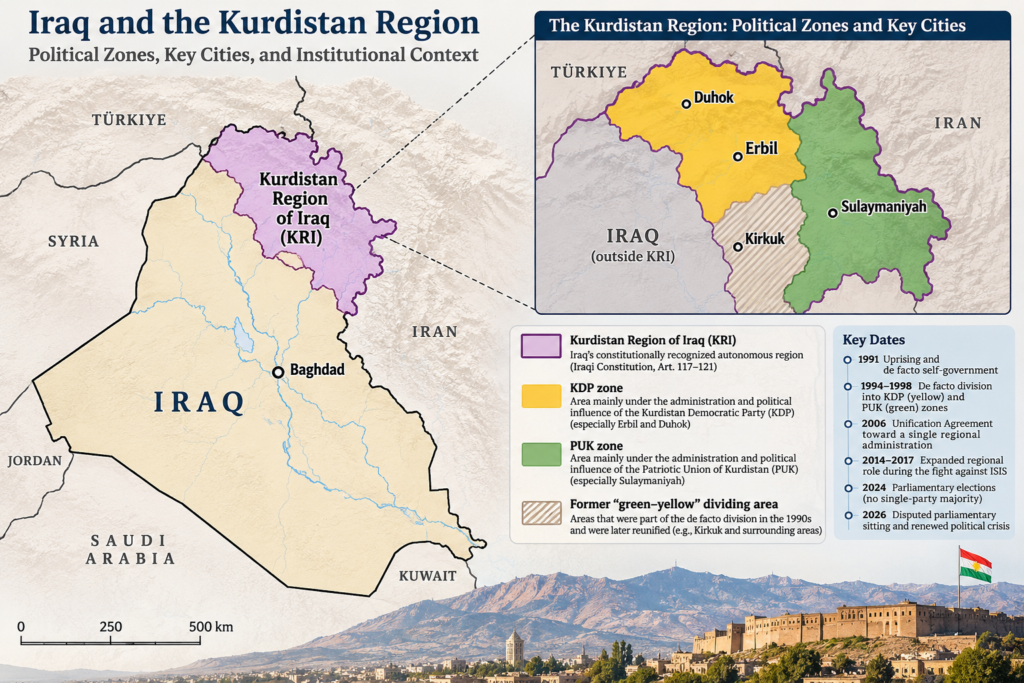
Kurdistan’s Political Deadlock: From Party Rule to Constitutional Government
Why the Region’s Institutional Crisis Cannot Be Resolved Without Rethinking Its Relationship with Iraq.
Dr Rebwar Fatah
Introduction: A Crisis Beyond Political Parties
The political crisis in the Kurdistan Region of Iraq is increasingly presented as a confrontation between the Kurdistan Democratic Party (KDP) and the Patriotic Union of Kurdistan (PUK). Each party accuses the other of obstructing political progress, undermining democratic procedures, or threatening the Region’s stability. In this confrontation, however, a more fundamental question has received insufficient attention: why has a region with decades of self-government and constitutionally recognized autonomy struggled to establish political institutions capable of functioning independently of its dominant parties?
The distinction matters. Political disagreements are normal in democratic systems. Parties compete for power, disagree over policies, and negotiate governing arrangements. The problem becomes institutional when disagreements between parties prevent elected bodies from exercising their constitutional responsibilities, or when the authority of public institutions depends upon agreements between political organizations rather than established legal procedures.
Kurdistan’s present crisis should therefore be understood not simply as a dispute over government formation, but as a test of the Region’s institutional development. The question is not whether the KDP or PUK should prevail. It is whether the Kurdistan Region can develop a political order in which neither party possesses the power to suspend, monopolize, or substitute itself for constitutional institutions.
1. The Immediate Political Crisis
The parliamentary elections of 20 October 2024 produced no single-party majority. The KDP secured 39 of the 100 seats, while the PUK obtained 23. The New Generation Movement won 15 seats, with the remainder distributed among other parties and minority representatives (Kurdistan24 2024). The results required political negotiations, but the subsequent failure to establish a new government prolonged institutional uncertainty.
On 4 November 2026, 52 members attended a sitting of the Kurdistan Parliament and elected Vala Fareed Ibrahim as Speaker, Rami Nuri Awdish as Deputy Speaker, and Mona Nabi Qahwachi as Secretary. The Parliament’s official account records 52 votes for each candidate. The KDP regarded the sitting as a lawful step towards restoring legislative activity; the PUK and other boycotting groups challenged its political legitimacy. The official account establishes what occurred in the chamber, but does not, by itself, settle every question about the session’s legal validity (Kurdistan Parliament 2026; Rudaw 2026a; AFP 2026).
The distinction between procedural validity and political legitimacy is central. A recorded numerical quorum is evidence relevant to the former, but a definitive legal judgment would require the applicable, binding standing orders, rules governing the continuation and convening of the inaugural sitting, and any authoritative judicial determination. Political agreements and a proposed regional constitution should not be treated as equivalent to binding law. Equally, a boycott cannot by itself supply an indefinite veto over the legislature. A constitutional system must protect both lawful majority decision-making and the rights of elected minorities.
On 5 November 2026, Rudaw reported a PUK decision to withdraw from the KRG cabinet amid the deepening dispute (Rudaw 2026b). The implications for executive continuity and any further proposals for separate administrative arrangements require verification against formal party and government decisions. Even without presuming their eventual outcome, the developments expose a structural weakness: regional institutions remain vulnerable when the effective exercise of authority depends upon agreements between political organizations whose influence extends beyond their parliamentary seats.
2. The Historical Problem: Political Authority and Institutional Fragmentation
The Kurdistan Region’s political institutions emerged under exceptional historical circumstances. Following the 1991 uprising, the withdrawal of central state administration and the international protection associated with the no-fly zone required Kurdish political organizations to assume responsibilities for administration, security and public finance (Stansfield 2003). These were initially institutions of survival and practical self-government, developed under uncertainty rather than through a settled constitutional process. Their origins help explain their form, but do not establish that their original arrangements must remain permanent.
The political divisions and armed confrontation of the mid-1990s contributed to the emergence of separate centers of authority associated with the KDP and PUK—the KDP-administered “yellow zone” headquartered in Erbil and the PUK-administered “green zone” headquartered in Sulaymaniyah (Stansfield 2003; Natali 2010). Subsequent efforts to reunify the administration, including the formal 2006 Unification Agreement, did not fully eliminate the distinct political and security structures associated with the two parties.²
This history explains why today’s dispute extends beyond ministerial appointments. Competition concerns security organizations, administrative appointments, public resources and territorially concentrated networks of authority. The more difficult historical question is how structures that arose in an emergency became enduring mechanisms for distributing power. Formal reunification and the existence of regional ministries are not, on their own, evidence that the effective authority of party-linked networks has disappeared (Stansfield 2003; Natali 2010).
Historical explanation must not become constitutional justification. The circumstances of the 1990s cannot provide a permanent rationale for parallel chains of command. Yet reunification must not simply transfer control from two parties to one. The test is whether institutions act under publicly known law, professional standards and enforceable accountability, whoever wins elections. In this sense, the difference between formal office and effective power is decisive: a minister may possess legal responsibility while appointments, expenditure or security decisions remain subject in practice to approval outside the ministry. The institutional task is to bring actual decision-making within accountable public authority.
3. Kurdistan’s Constitutional Position Within Iraq
The Kurdistan Region’s future cannot be examined independently of Iraq’s constitutional framework. Article 117 of the 2005 Iraqi Constitution recognizes Kurdistan as a federal region; Article 120 contemplates a regional constitution consistent with the federal Constitution; and Article 121 recognizes regional legislative, executive and judicial powers except in matters assigned exclusively to the federal authorities (Republic of Iraq 2005, arts. 117, 120–121). These provisions must be read alongside the Constitution’s allocation of exclusive and shared competencies and its mechanisms for resolving disputes.
These provisions establish a fundamental principle: Kurdistan’s autonomy is part of Iraq’s constitutional order, rather than a discretionary concession from Baghdad. Nevertheless, constitutional autonomy does not remove the obligation to establish accountable institutions within the Region itself. Regional self-government and internal democracy are distinct matters. A region may possess extensive powers in relation to the federal government while concentrating those powers within a narrow political structure.
This produces two separate constitutional questions:
- 1. External Relations: The division of authority between Baghdad and Erbil regarding federal powers, regional powers, public revenues, security responsibilities, and mechanisms for resolving disputes (Wolff 2010, 28–31).
- 2. Internal Governance: The distribution and exercise of power within Kurdistan regarding the relationship between parliament and government, judicial independence, administrative neutrality, local self-government, and civilian oversight of security institutions.
Both questions must be addressed. Greater federal intervention would not necessarily resolve internal institutional weaknesses. Equally, defending regional autonomy cannot justify the absence of effective parliamentary oversight or the continued political division of public institutions. A democratic Kurdistan and a functioning Iraqi federation should be understood as complementary constitutional objectives, not competing alternatives.
4. The Wider Iraqi Problem
Kurdistan’s institutional difficulties are not entirely unique. Across Iraq, political parties and armed organizations have exercised influence through arrangements that do not always correspond neatly to the formal constitutional distribution of powers (Dodge 2012, 142–146). The relationship between political authority, security institutions, public employment, and access to state resources remains a central challenge to governance.
This broader context is important for two reasons:
- First, it prevents an inaccurate comparison between a politically divided Kurdistan and an otherwise fully consolidated federal state.
- Second, it demonstrates that the solution cannot simply consist of transferring authority from regional political organizations to federal political organizations.
The objective must be the development of institutions that can operate independently of partisan control at both levels. In this respect, reforms intended to strengthen the authority of the federal government require the same scrutiny as reforms within Kurdistan. Strengthening the capacity of a government to enforce the law is not identical to establishing constitutional accountability. Effective state authority must coexist with judicial independence, parliamentary scrutiny, legal limits, and protection against arbitrary action. Otherwise, institutional consolidation risks becoming a new concentration of power.
5. From Political Agreement to Constitutional Government
The immediate priority is to restore the regular functioning of Kurdistan’s elected institutions through lawful and transparent procedures. This requires a clear distinction between the legitimate interests of political parties and the responsibilities of public institutions. Parties are entitled to negotiate coalition agreements, contest government policies, and pursue electoral programs. They should not possess an indefinite veto over parliamentary activity or exercise governmental authority outside the constitutional framework.
A sustainable institutional settlement requires several interconnected reforms:
- Parliamentary Accountability: The Kurdistan Parliament must be capable of meeting, legislating, scrutinizing expenditure, and holding the executive accountable without depending on continuous agreement between the principal parties.
- Judicial Independence and Legal Remedies: Disputes over parliamentary procedure, executive powers and constitutional competencies need credible adjudication by courts with jurisdiction under existing law. Strengthening judicial independence, access to remedies and compliance with judgments is essential; any proposed new regional constitutional adjudication mechanism would require a separate assessment of its legal basis and its relationship with federal judicial authority.
- Professional Public Administration: Recruitment, promotion, and the allocation of public resources should be governed by transparent criteria and subject to independent meritocratic review.
- Civilian Control of Security Institutions: Peshmerga formations and internal security bodies should operate through transparent legal chains of command and civilian oversight rather than rival partisan command structures. Integration of the historically distinct 70 and 80 forces must be assessed against actual command arrangements, legislation, budgetary control and feasible protections for personnel, rather than assumed to follow automatically from an administrative announcement (Stansfield 2003; Natali 2010).
- Meaningful Local Self-Government: Elected local governorate councils should possess sufficient powers and predictable resources to address the needs of their communities without unnecessary dependence on centralized party administration.
These reforms require a sequence rather than a single bargain. Immediately, parliament should resume regular work under verifiable rules, form its committees, scrutinize executive continuity and protect the uninterrupted provision of public services. In the medium term, legislation and administrative practice should improve budget disclosure, independent audit, merit-based appointments, judicial remedies and civilian security oversight. Over a longer period, the Region must develop genuinely independent professional, civic and local institutions and clarify unresolved federal-regional competencies. Each step should have a legal basis, a responsible institution, public benchmarks and safeguards against the replacement of one partisan monopoly by another.
6. The Citizen as the Center of Constitutional Reform
Institutional reform will remain incomplete if citizens are regarded only as recipients of services. Government is certainly experienced through salaries, healthcare, schools, roads, banking, employment and protection from arbitrary treatment. But citizens must also be able to question decisions, obtain public information, organize independently and participate in shaping the institutions that govern them. Constitutional citizenship is both an entitlement to public provision and a capacity to hold power accountable.
These are not secondary considerations. They are among the principal ways citizens evaluate whether public authority serves their interests. Kurdistan possesses considerable human, geographical, and economic resources. Yet the quality and accessibility of public services remain important questions for evaluating the performance of successive administrations.
A serious reform programme should therefore connect institutional accountability with measurable improvements in public provision:
- 1. Financial Transparency: Transparent public finances allow citizens and parliamentarians to examine how oil and non-oil revenues are allocated.
- 2. Administrative Neutrality: Professional administration reduces dependence on party patronage networks when accessing employment or state services.
- 3. Independent Oversight: Regulatory oversight strengthens public confidence in decisions concerning infrastructure, healthcare, and education.
Better services do not automatically produce democracy: parties may expand provision while retaining discretionary control over access. The more demanding objective is to make services available through clear rights and impartial procedures, including accessible complaints and review mechanisms. Independent media, professional associations, universities, civic organizations and genuinely empowered local councils can help citizens examine public choices without requiring the sponsorship of a dominant party. Such institutions cannot be created by decree alone; they need legal protection, stable resources and space for disagreement.
7. Rebuilding Connections Across Iraq
Kurdistan’s relationship with Iraq cannot be reduced to constitutional provisions or revenue negotiations. Conflict and the separation of Kurdish-administered areas from Baghdad between 1991 and 2003 weakened important institutional and social connections. Later constitutional recognition did not automatically reconstruct them. A federation is not merely a division of powers: it is also a framework in which communities can form shared interests without relinquishing their distinct languages, histories and identities.
This suggests an additional dimension of federal reform: creating opportunities for citizens to experience the wider country without compromising their distinct identities.
- Transport Infrastructure: An integrated national transit and railway network linking major Iraqi cities—including Erbil and Sulaymaniyah—could facilitate employment, education, commerce, and family travel. Subsidized fares for low-income households and robust safety guarantees for all passengers would make national mobility accessible and safe.
- Higher Education: Student exchanges, reciprocal university scholarships, joint academic research projects, and mutual recognition of qualifications could encourage young Iraqis to study and work across regional boundaries while fully protecting regional linguistic and cultural rights.
- Domestic Tourism: Affordable cultural travel initiatives allowing families from central and southern Iraq to visit Kurdistan’s northern mountain regions, and Kurdish families to visit historical sites in southern Iraq, could foster voluntary inter-community contact.
A federation is not sustained solely by bargains among elites. It also depends on voluntary relationships created through education, work, travel and everyday encounters. Integration must not mean assimilation; autonomy need not entail isolation. Transport links, university cooperation and affordable travel are therefore not substitutes for constitutional reform, but practical ways of making a shared constitutional order meaningful to citizens.
8. A Constitutional Model for Coexistence
The institutional objective should not be to eliminate Kurdistan’s political or cultural distinctiveness, nor should it be to create a uniform Iraqi identity imposed from Baghdad. A functioning federation must permit different communities to maintain their languages, cultures, and political preferences while participating in shared constitutional institutions.
The distribution of powers must be made sufficiently clear to be administered and adjudicated, without pretending that every federal disagreement can be eliminated. Federal authorities should exercise their constitutionally assigned responsibilities, including national defense and foreign policy; regional authorities should retain their protected competencies; and local government should receive powers and resources appropriate to local needs. Disputes over revenues, security and administration require published rules, credible negotiation and lawful adjudication rather than recurrent improvised bargains (Republic of Iraq 2005, arts. 110–121).
Disputed territories, particularly Kirkuk, require specific attention. Their populations include communities with distinct historical experiences and competing political claims. Constitutional questions concerning these territories cannot simply be set aside; Article 140 of the 2005 Constitution remains central to their legal status (Republic of Iraq 2005; Wolff 2010, 1365–1368).
At the same time, residents’ access to healthcare, education, local infrastructure, and cultural rights should not depend entirely on the final resolution of territorial status. Strong local government, safeguards for minority representation, and transparent public funding could help reduce the extent to which ordinary public services become instruments of territorial competition.
9. The Obstacles to ReformA credible proposal must acknowledge the entrenched interests that may obstruct institutional change:
- Political organizations controlling administrative appointments, security structures, or public resources may perceive reforms as threats to their influence.
- Citizens dependent on party-linked public employment may fear that institutional restructuring will endanger their livelihoods.
- Communities with histories of repression may interpret changes in the distribution of power as potential threats to their security or identity.
These concerns cannot be dismissed by invoking constitutional principles alone. Reform requires legal safeguards, credible transition arrangements and transparent procedures. Civil servants should not lose their livelihoods merely because appointments become politically neutral; security personnel require lawful professionalization, integration or restructuring. Reforms must also anticipate resistance from those who benefit from discretion and patronage, while distinguishing legitimate fears of insecurity from claims to permanent partisan control.
The transition must also avoid treating constitutional reform as a substitute for political participation. Political parties will continue to exist and compete. The objective is not to remove parties from politics, but to establish enforceable boundaries between partisan interests and public authority. Independent civil society organizations, professional associations, universities, and media can contribute by scrutinizing reform proposals and providing spaces for public debate. International organizations may offer technical assistance where requested, but ultimate responsibility for the legitimacy and direction of reform remains with the people and institutions of Iraq and the Kurdistan Region.
The transition from party rule to constitutional government is not simply a matter of redistributing political authority or reforming administrative structures. It also requires a transformation in the relationship between citizens and public institutions. Where access to employment, public services, and protection depends upon political affiliation, party loyalty may become a practical necessity rather than merely an expression of political preference. Constitutional reform must therefore create conditions in which citizens can
exercise their rights, pursue their livelihoods, and participate in public life without requiring the patronage of political organizations. The ultimate measure of institutional transformation is not whether political parties become weaker, but whether citizens become less dependent upon them.
Conclusion: What Kind of Government Does Kurdistan Need?
The present political deadlock raises questions that extend far beyond the formation of the next cabinet. The Kurdistan Region has acquired extensive experience of self-government, established public institutions, and developed political structures recognized within Iraq’s federal Constitution. Yet the persistence of party-based institutional divisions reveals the limits of an arrangement in which public authority remains closely connected to competing political organizations.
The immediate challenge is to restore effective parliamentary and governmental activity through lawful, transparent procedures. The longer-term challenge is to ensure that institutions can function regardless of which party controls them. Neither the victory of one party nor the preservation of a particular power-sharing formula answers that question. The essential distinction is between formal office and effective authority: political organizations must com
pete for public office, but the decisions attached to that office must be taken under law, subject to scrutiny and review.
Kurdistan’s constitutional future must therefore be considered in relation to the wider Iraqi federation. A democratic regional government requires constitutionally protected autonomy; a functioning federation requires regional institutions capable of exercising that autonomy lawfully and accountably. The reform agenda should also extend beyond the organization of government to be visible in citizens’ everyday lives—in hospitals, schools, public administration, transport, and economic opportunity.
The central question facing Kurdistan is not simply who will govern after the present crisis. It is whether a system whose institutions were created and sustained through party authority can become one in which parties exercise power within constitutional limits. Success would be visible not only in parliamentary proceedings but also in independent decisions, enforceable rights, impartial services and citizens able to act beyond the boundaries of party affiliation.
Endnotes
1. The official parliamentary record documents the vote and names of officeholders; contemporary reporting records the boycott and political objections. Neither is substituted here for a judicial ruling on contested procedural questions (Kurdistan Parliament 2026; Rudaw 2026a).
2. The historical discussion distinguishes the 2006 administrative reunification from the separate empirical question of whether security command, personnel and budgets have been integrated in practice. Specific current command claims should be checked against up-to-date official and independent documentation.
References
Agence France-Presse (AFP). 2026. ‘Iraqi Kurdistan Selects Parliament Speaker after Two-Year Deadlock.’ 4 November. https://www.arabnews.com/middle-east/iraqi-kurdistan-selects-parliament-speaker-after-two-year-deadlock-3009847
Dodge, Toby. 2012. Iraq: From War to a New Authoritarianism. London: International Institute for Strategic Studies.
Kurdistan Parliament. 2026. ‘Kurdistan Parliament Elects Presidency Board.’ 4 November. https://www.parliament.krd/english/parliament-business/latest-news/posts/2026/november/kurdistan-parliament-elects-presidency-board/
Kurdistan24. 2024. ‘Final Results: Complete Breakdown of Kurdistan Parliament’s Sixth Cycle Election Outcomes.’ 22 October (reporting preliminary seat distribution). https://www.kurdistan24.net/en/story/807430
Natali, Denise. 2010. The Kurdish Quasi-State: Development and Dependency in Post-Gulf War Iraq. Syracuse: Syracuse University Press.
Republic of Iraq. 2005. Constitution of the Republic of Iraq, especially arts. 110–121 and 140. English text: https://www.constituteproject.org/constitution/Iraq_2005.pdf?lang=en
Rudaw. 2026a. ‘Kurdistan Parliament Elects Presidency amid Widespread Session Boycott.’ 4 November. https://www.rudaw.net/english/categories/kurdistan/1080017
Rudaw. 2026b. ‘PUK Decides to Withdraw from KRG Cabinet amid Deepening Political Rift.’ 5 November. (Referenced in Rudaw’s 4 November parliamentary coverage; original report to be checked before publication.)
Stansfield, Gareth R. V. 2003. Iraqi Kurdistan: Political Development and Emergent Democracy. London: RoutledgeCurzon.
Wolff, Stefan. 2010. ‘Governing (in) Kirkuk: Resolving the Status of a Disputed Territory in Post-American Iraq.’ International Affairs 86 (6): 1361–1379.
Author Profile

- Dr Rebwar Fatah
- Dr Rebwar Fatah is a London based Middle East and North Africa (MENA) expert, provides expert analysis on the complex dynamics shaping the region. Beyond his professional pursuits, Dr Fatah is an accomplished writer, poet, and photographer, bringing a unique creative perspective to his observations of the world.
 Uncategorised6 November 2026Kurdistan’s Political Deadlock: From Party Rule to Constitutional Government
- Opinion3 June 2026The Aborted Front: Türkiye’s Veto and the Geopolitics of Arming Iranian Kurds
- Talabani24 May 2026Dynasty and Deadlock: The KRG Governance Crisis
- Uncategorised19 May 2026The House That Was Never Built: On the Failure of Institution-Building and the Crisis of Collective Vision in Post-1991 Kurdistan