The Aborted Front: Türkiye’s Veto and the Geopolitics of Arming Iranian Kurds
Dr Rebwar Fatah
Abstract
This article investigates the strategic and diplomatic failure of the joint United States–Israeli covert operation designed to open an eastern front against Tehran following the outbreak of the 2026 war. Utilizing a network of armed Iranian Kurdish dissident factions based in Iraqi Kurdistan, the operation was abruptly abandoned following a direct diplomatic intervention by Turkish President Recep Tayyip Erdoğan. This paper draws on elite diplomatic reporting, think-tank analyses, and conflict event data to critically deconstruct the subsequent political fallout, focusing on the accountability-shifting rhetoric deployed by the Trump administration and the defensive diplomatic maneuvering of the Kurdistan Regional Government (KRG). It argues that President Trump’s public allegations regarding “stolen” or “intercepted” weapons constituted a calculated misdirection to obscure a significant foreign policy capitulation to Ankara. Concurrently, it examines how Prime Minister Masrour Barzani’s public denials functioned as a vital survival mechanism to shield Erbil from devastating Iranian asymmetric retaliation and Turkish economic strangulation.
1. The Covert Blueprint and the Turkish Strategic Veto
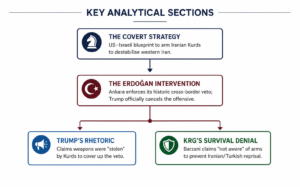
In the opening months of the 2026 conflict, US and Israeli intelligence agencies sought to exploit Iran’s domestic vulnerabilities by mobilizing transnational Kurdish opposition groups — including Komala, PJAK, and PAK — headquartered in northern Iraq (Hayman 2026a). This approach was consistent with a documented historical pattern of US covert engagement with proxy forces across the Middle Eastern theatre, a strategy whose structural logics and recurring failure modes have been extensively analyzed in the policy literature (Byman 2007; Cronin 2013). The operational objective was to supply these factions with sufficient materiel to seize and hold territory within western Iran, leveraging localized economic grievances — rooted in the marginalization of Kurdish communities documented extensively since at least the 2022 “Woman, Life, Freedom” uprising — into a broader armed insurgency (Reuters 2026).
This plan collided directly with Türkiye’s foundational security paradigm, which regards any cross-border Kurdish military empowerment as an existential threat to its own territorial integrity — a posture rooted in the decades-long conflict with the PKK and operationalized through Türkiye’s periodic military incursions into northern Iraq, including Operations Claw-Eagle, Claw-Tiger, and Claw-Lock (2019–2022) (Güneş and Zeydanlıoğlu 2014; IISS 2023). Following high-level phone calls between President Erdoğan and the White House, the Trump administration yielded to Turkish pressure and ordered an immediate freeze on the operation (The Jerusalem Post 2026). This intervention demonstrated that Türkiye retains a definitive veto-player role capable of disrupting Allied grand strategy — a structural leverage rooted in its NATO membership, the strategic significance of the Incirlik Air Base facility, and Washington’s persistent dependence on Ankara’s acquiescence for access to the broader Middle Eastern theatre (Zanotti and Thomas 2022).
2. Deconstructing Trump’s “Missing Weapons” Narrative
To manage the domestic and international blowback of an aborted military campaign, President Trump pivoted to a narrative of logistical betrayal. In public statements broadcast via social media and press availability, Trump asserted that the United States had dispatched “a lot of rifles” to arm Iranian opposition forces, while explicitly accusing Kurdish intermediaries of intercepting or diverting the shipments (Al Jazeera 2026). This framing placed Kurdish leadership under intense international scrutiny, casting them as unreliable and self-serving actors.
Yet investigative reporting and categorical denials from the targeted dissident organizations revealed a conflicting picture: the heavily militarized, multi-layered security architecture spanning the Iran–Iraq border — including IRGC surveillance drones, regular Iraqi border force patrols, and Iranian ballistic interdiction capacity — rendered the clandestine delivery of large-scale military hardware virtually impossible (The New Arab 2026; ISW 2026). The “missing weapons” narrative therefore functioned primarily as political cover, allowing the White House to reframe a strategic retreat as a logistical betrayal by an unreliable proxy rather than as a capitulation compelled by Ankara’s diplomatic ultimatum.
This rhetorical maneuver has a documented precedent in US foreign policy. When the CIA-backed Syrian rebel programme collapsed in 2017, a comparable dynamic emerged: senior officials attributed the programme’s failure to the inadequacy of the proxies rather than to the structural impossibility of the mission’s objectives (Miller 2018; Filkins 2017). In both cases, “blame-the-proxy” rhetoric served to insulate the administration from accountability while simultaneously degrading the international credibility of the proxy partners themselves.
3. Erbil’s Tripartite Trap: Prime Minister Barzani’s Calculated Silence
Washington’s rhetoric placed the KRG in an acutely perilous geopolitical position. Confirming the weapons transfers would have provided Tehran with an actionable casus belli to launch ballistic missile and drone strikes against Iraqi Kurdistan — a threshold Iran had already demonstrated a willingness to cross, most recently in the January 2024 IRGC strike on Erbil and the late May 2026 ballistic missile attacks on PAK command infrastructure (The New Region 2026; ACLED 2026). Simultaneously, any confirmation risked triggering retaliatory economic measures from Ankara, given the KRG’s profound structural dependence on Turkish trade routes, energy revenue, and the Kirkuk–Ceyhan export pipeline — the primary conduit for KRG oil exports, which in 2023 accounted for the vast majority of the Region’s public revenues (KRSO 2023; World Bank 2024).
Prime Minister Masrour Barzani’s public declaration that the KRG was “not aware” of any such weapons deliveries constituted a masterclass in regional survival diplomacy (The New Region 2026). By maintaining official ignorance, Barzani achieved a threefold strategic objective: he simultaneously de-escalated the immediate military threat from Tehran, reassured Ankara that Erbil was not actively facilitating armed Kurdish nationalism across the Iranian border, and furnished Washington with a convenient logistical cover story that allowed the administration to permanently shelve a compromised and politically toxic policy.
This posture is consistent with an established pattern of KRG “studied ambiguity” in relation to sensitive security operations — a behavior observable in earlier episodes, including the KRG’s careful non-denial of US special forces presence during anti-IRGC operations in 2019. In this respect, Barzani’s denial reflects a learned institutional response rather than a singular reactive decision: the product of decades of navigating the overlapping and frequently contradictory security demands of Baghdad, Tehran, Ankara, and Washington (Natali 2005; Romano 2006).
4. The Fractured Alignment of Iranian Kurdish Factions
A rigorous analysis must resist treating “the Iranian Kurds” as a monolithic actor. The US-Israeli operational blueprint rested on a newly formed and internally volatile umbrella alliance — the Coalition of Political Forces of Iranian Kurdistan — established between February and March 2026 (Palani 2026).
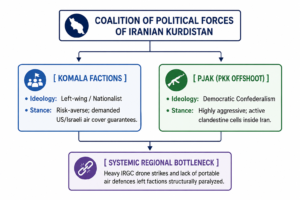
While this coalition brought together a significant number of battle-tested, lightly armed fighters — open-source estimates varied considerably across reporting, ranging from several thousand to upwards of ten thousand, reflecting the inherent difficulty of verifying non-state force strength in this operating environment (JINSA 2026) — it bridged deep and historically entrenched ideological divides. The internal friction these divisions generated helps explain why the operation encountered severe structural obstacles before Türkiye’s diplomatic veto was even enacted.
5. Komala: Left-Wing Nationalism and the Logic of Risk Mitigation
The Komala movement — divided primarily between the Komala Party of Iranian Kurdistan, led by Abdullah Mohtadi, and the Komala of the Toilers of Kurdistan — traces its leftist, socialist-nationalist lineage to its founding in 1969. One of the earliest organized Kurdish political movements in Iran, Komala played a prominent role in the immediate aftermath of the 1979 Revolution before being suppressed by the Islamic Republic, and subsequently reconstituted its organizational base in exile in Iraqi Kurdistan (Jwaideh 2006; Entessar 1992). Historically influential in urban centers and among Kurdish intelligentsia, and briefly resurgent during the 2022 “Woman, Life, Freedom” uprising, Komala brought substantial mass organizational capacity and a clandestine civilian network to the 2026 coalition.
When approached by US and Israeli planners to spearhead a cross-border incursion from Iraqi territory, Komala’s leadership adopted a firmly risk-averse posture grounded in operational realism. Having spent decades sustaining camps and political offices in northern Iraq under constant Iranian threat, the party’s commanders were acutely aware of their conventional military limitations (Chatham House 2026). Komala leadership openly resisted committing forces to what they characterized as a mission without adequate protection, insisting on explicit, ironclad guarantees of US-Israeli air superiority and access to advanced man-portable air-defense systems (MANPADS) before any cross-border commitment could be countenanced (Chatham House 2026).
Iran’s Islamic Revolutionary Guard Corps (IRGC) validated this caution through preemptive action. Intensified drone and ballistic missile strikes against Komala’s established camp infrastructure — including the Zargwezla base in the Sulaymaniyah governorate — throughout March and May 2026 demonstrated concretely that lightly armed infantry units could not survive a sustained cross-border push without continuous Western air cover (ACLED 2026). This operational reality made Komala’s mobilization timeline structurally incompatible with Washington’s desire for a rapid opening of the western front.
6. PJAK: The Radical Outsider and the Turkish Flashpoint
The inclusion of the Kurdistan Free Life Party (PJAK) in the February 2026 coalition represents the operation’s single most diplomatically volatile element. Established in 2004, PJAK is structurally and ideologically an offshoot of the Kurdistan Workers’ Party (PKK), adhering to Abdullah Öcalan’s doctrine of “democratic confederalism” — a model of decentralized, gender-equal, ecologically oriented governance that rejects the nation-state framework in favor of networked cantonal self-administration (Öcalan 2011; Gunter 2013).
PJAK’s guerrilla lineage made it arguably the coalition’s most tactically aggressive actor. Conflict event data from the preceding decade indicates that PJAK-attributed incidents account for the largest single share of non-state armed group engagements against Iranian security forces in the Kurdistan region of Iran (ACLED 2026). Immediately following the 2026 war’s outbreak, PJAK bypassed conventional command structures, publicly calling on civilians within Iranian Kurdistan to establish autonomous “local governance and self-defense committees” — a move consistent with Öcalan’s doctrine but acutely destabilizing to the coalition’s operational security.
PJAK’s presence fatally compromised the US-Israeli operation across two simultaneous vectors. First, PJAK has carried a US Treasury Department Specially Designated Global Terrorist designation since 2009 due to its institutional relationship with the PKK, rendering any overt CENTCOM arming arrangement legally untenable and politically radioactive within Washington — a constraint the Congress.gov (2026) analysis makes explicit. This designation is documented in the original OFAC press release of February 4, 2009 (US Department of the Treasury 2009), which cites PJAK’s shared leadership structures, training pipelines, and ideological framework with the PKK. Second — and more consequentially for the operation’s diplomatic survival — PJAK constituted the precise trigger for Erdoğan’s intervention. For Ankara, any operation that strengthened PJAK, even one directed exclusively at Tehran, would inevitably channel weapons, combat training, and territorial safe havens to the PKK along Türkiye’s southern flank (Hayman 2026b). Erdoğan’s communications with Trump explicitly weaponized PJAK’s coalition membership, forcing the White House to confront the zero-sum reality that backing the coalition meant materially strengthening Türkiye’s designated primary existential adversary (The Jerusalem Post 2026).
7. PDKI and PAK: Traditionalists and Combat Veterans
The Democratic Party of Iranian Kurdistan (PDKI), founded in 1946 in the context of the short-lived Mahabad Republic, stands as the oldest political organization in Rojhelat and retains the deepest roots among traditional Kurdish nationalists. Its founding is inseparable from the broader Kurdish national awakening of the mid-twentieth century — a movement whose intellectual and organizational history is comprehensively documented in Eagleton’s (1963) foundational study of the Mahabad Republic and Jwaideh’s (2006) synthetic overview of the Kurdish national movement. The PDKI’s orientation within the 2026 coalition was strictly institutionalist: its leadership demanded a negotiated transition toward a federalized Iranian state in which Kurdish cultural and political autonomy would be legally codified rather than militarily imposed (Palani 2026).
The Kurdistan Freedom Party (PAK) occupied a uniquely tactical position within the coalition. Its fighters had received direct training from Western military advisors during the US-led coalition’s counter-ISIS campaign in Iraq, giving PAK a level of conventional frontline competence — including unit cohesion, logistics discipline, and combined-arms awareness — that the other factions demonstrably lacked (JINSA 2026). This made PAK the preferred candidate for a coalition spearhead force. It also rendered PAK the primary target of Iranian reprisal: documented ballistic missile strikes against PAK command infrastructure near Erbil in late May 2026 effectively degraded the party’s operational capacity at the precise moment the broader campaign was being aborted (The New Region 2026; ACLED 2026).
Analytical Synthesis
Integrating the preceding analysis reveals that the joint US-Israeli operation was structurally compromised from its inception — not merely undone by Turkish pressure at the eleventh hour. The coalition was paralyzed simultaneously from within and without. Internally, a profound trust deficit pervaded the alliance: Kurdish commanders, drawing on a documented history of US abandonment in northern Syria — most acutely following the October 2019 withdrawal that exposed Syrian Democratic Forces to Turkish offensive operations — refused to commit forces without guarantees that Washington was both unable and structurally unwilling to provide (Natali 2005; Middle East Institute 2020). Externally, the inclusion of PJAK generated an irreconcilable diplomatic contradiction: the West was attempting to execute a covert, plausibly deniable regime-change operation using a designated terrorist organization (Congress.gov 2026; US Department of the Treasury 2009), knowing that Türkiye — a NATO ally with an effective veto over regional access — regarded that organization as its foremost security threat.
When Trump subsequently claimed the weapons were “stolen,” he was not merely fabricating a cover story in isolation. He was deliberately exploiting the pre-existing rivalries, historical grievances, and factional opacity of the Kurdish political landscape (Al Jazeera 2026) — leveraging outsider misperceptions of Kurdish unity to construct a narrative superficially plausible to domestic and international audiences unfamiliar with the movement’s internal fractures. This narrative architecture allowed the White House to reframe a strategic retreat as a logistical betrayal, insulating the administration from accountability for a policy that had collapsed under the combined weight of its own internal contradictions and a decisive Turkish diplomatic veto.
The longer-term consequences of this episode extend beyond the immediate operational failure. The deployment of “blame-the-proxy” rhetoric against the KRG and the broader Kurdish coalition has further eroded the credibility deficit that Washington carries in this relationship — a deficit with direct implications for the KRG’s future willingness to serve as a platform for US covert and overt operations in the region. Should the United States require Kurdish cooperation for future contingencies involving Iran, the political capital expended by the Trump administration’s accountability-shifting rhetoric will constitute a measurable structural liability.
References
ACLED (Armed Conflict Location and Event Data Project). 2026. Disaggregated conflict event data, Iranian Kurdistan and KRI, January–May 2026. acleddata.com.
Al Jazeera. 2026. “Trump Says US Armed Iranian Dissidents via Kurds; Kurdish Groups Deny Claim.” April 6.
Byman, Daniel. 2007. “Friends Like These: Counterinsurgency and the War on Terrorism.” International Security 31 (2): 79–115.
Chatham House. 2026. “Kurdish Groups in Iran Face Risky Dilemma Amid Unclear US Endgame.” March 9. chathamhouse.org.
Congress.gov. 2026. “Iranian Kurds and Possible Support.” Congressional Research Service, Report IF13172. March 6.
Cronin, Audrey Kurth. 2013. “Why Drones Fail: When Tactics Drive Strategy.” Foreign Affairs 92 (4): 44–54.
Eagleton, William. 1963. The Kurdish Republic of 1946. Oxford: Oxford University Press.
Entessar, Nader. 1992. Kurdish Ethnonationalism. Boulder, CO: Lynne Rienner Publishers.
Filkins, Dexter. 2017. “America’s Proxy War in Syria.” The New Yorker, October 2.
Güneş, Cengiz, and Welat Zeydanlıoğlu, eds. 2014. The Kurdish Question in Türkiye: New Perspectives on Violence, Representation and Reconciliation. London: Routledge.
Gunter, Michael M. 2013. Out of Nowhere: The Kurds of Syria in Peace and War. London: Hurst.
Hayman, Tamir. 2026a. Interview by Margaret Hoover. Firing Line, PBS. May 29.
Hayman, Tamir. 2026b. “Behind the Secret Plan: How Regional Dynamics Halted the Covert Iranian Campaign.” Interview by Ronen Bergman. Ynetnews, June 1.
IISS (International Institute for Strategic Studies). 2023. “Turkish Military Operations in Northern Iraq: Strategic Logic and Regional Impact.” IISS Strategic Comments 29 (3).
ISW (Institute for the Study of War). 2026. “IRGC Border Interdiction Posture and Force Disposition: Iran-Iraq Frontier Assessment.” May 2026. understandingwar.org.
The Jerusalem Post. 2026. “Sources Confirm Donald Trump Vetoed Kurdish Aid Plan Following Ankara Call.” May 14.
JINSA. 2026. “Iran’s Kurdish Coalition and the Future of the Opposition.” Jewish Institute for National Security of America, March 18. jinsa.org.
Jwaideh, Wadie. 2006. The Kurdish National Movement: Its Origins and Development. Syracuse: Syracuse University Press.
KRSO (Kurdistan Region Statistics Office). 2023. Kurdistan Region Economic Indicators 2023. Erbil: KRSO.
Middle East Institute. 2020. “The US Withdrawal from Syria and Its Impact on the Kurdish Question.” MEI Policy Paper, January 2020. mei.edu.
Miller, Greg. 2018. The Apprentice: Trump, Russia, and the Subversion of American Democracy. New York: Custom House.
Natali, Denise. 2005. The Kurds and the State: Evolving National Identity in Iraq, Türkiye, and Iran. Syracuse: Syracuse University Press.
The New Arab. 2026. “How Did US Weapons Intended for Iranian Kurds ‘Disappear’?” May 2.
The New Region. 2026. “KRG ‘Not Aware’ of US Weapon Deliveries: PM Barzani.” May 24. thenewregion.com.
Öcalan, Abdullah. 2011. Democratic Confederalism. London: Transmedia Publishing.
Palani, Halmat. 2026. “Kurdish Alliance Announced in Iran is a Historic Step and a High-Stakes Gamble.” TISHK Center for Kurdistan Studies, February 28. tishk.org.
Reuters. 2026. “Exclusive: Israel Backing Iranian Kurdish Plans to Seize Iran Border Areas, Sources Say.” March 6.
Romano, David. 2006. The Kurdish Nationalist Movement: Opportunity, Mobilization and Identity. Cambridge: Cambridge University Press.
US Department of the Treasury. 2009. “Treasury Designates Free Life Party of Kurdistan.” OFAC Press Release, February 4. treasury.gov.
World Bank. 2024. Iraq Economic Monitor: Kurdistan Region Fiscal Assessment. Washington, DC: World Bank Group.
Zanotti, Jim, and Clayton Thomas. 2022. “Türkiye: Background and US Relations.” Congressional Research Service Report R41368. Washington, DC: CRS.
Author Profile

- Dr Rebwar Fatah is a London based Middle East and North Africa (MENA) expert, provides expert analysis on the complex dynamics shaping the region. Beyond his professional pursuits, Dr Fatah is an accomplished writer, poet, and photographer, bringing a unique creative perspective to his observations of the world.
 Uncategorised3 June 2026The Aborted Front: Türkiye’s Veto and the Geopolitics of Arming Iranian Kurds
- Barzani24 May 2026Dynasty and Deadlock: The KRG Governance Crisis
- Uncategorised19 May 2026The House That Was Never Built: On the Failure of Institution-Building and the Crisis of Collective Vision in Post-1991 Kurdistan
- Kurdistan15 March 2026Halabja: A Legacy of Poison, Politics, and Unfinished Justice