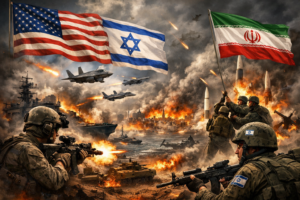
The Three Stages of the US-Israeli War Against Iran: From Diplomacy to Covert Ground Operations
Dr Rebwar Fatah, London based MENA expert
Abstract
This article examines the US-Israeli military campaign against Iran in 2026, tracing its evolution through three distinct stages: pre-war diplomacy, a sustained air campaign, and the reported involvement of Kurdish opposition forces in ground operations. Drawing on primary reports and media accounts, it highlights the strategic interplay between diplomacy and military action, revealing how parallel negotiations and covert preparations shaped the conflict. The analysis situates these developments within the literature on coercive diplomacy, compellence, and proxy warfare, emphasizing the deliberate ambiguity in US war aims and the use of third-party actors to achieve strategic objectives while minimizing direct costs. The study also considers regional and domestic pressures, including Iran’s responses, Turkey’s concerns, and American public opinion, illustrating the complex dynamics that influence both the conduct and potential duration of modern military interventions.
Keywords: US-Israeli conflict, Iran, coercive diplomacy, proxy warfare, Kurdish opposition, military strategy, regime change
Introduction
In late February 2026, the Middle East witnessed a dramatic escalation as the United States and Israel launched a coordinated military campaign against Iran, marking the largest American military operation in the region in two decades (ABC News Australia, 2026). What began as diplomatic negotiations over Iran’s nuclear program, ballistic missile development, and regional proxy networks rapidly transformed into a full-scale conflict that has already claimed hundreds of lives and drawn in multiple regional actors (BBC News, 2026).
This article examines the three distinct stages of this evolving war, tracing its trajectory from failed diplomacy through aerial bombardment to the controversial involvement of Kurdish opposition groups in ground operations. The analysis is framed within the theoretical literature on coercive diplomacy, deterrence, and proxy warfare, which helps explain the logic underpinning the US-Israeli strategy (George, 1991; Schelling, 1966; Pape, 1996; Byman and Waxman, 2002).
Stage One: The Diplomatic Prelude and Negotiation Objectives
The Geneva Talks and Pre-War Diplomatic Efforts
Prior to the outbreak of hostilities, the Trump administration pursued a dual-track approach of diplomacy backed by military preparations. Even as the US dispatched envoys to nuclear talks with Iran in Geneva and Oman, American and Israeli military planners had been working for months on what would become Operation Epic Fury, with the timing for the attack decided weeks in advance (The Vibes, 2026). This parallel strategy reflected a deep skepticism within the administration about the viability of diplomatic engagement with Tehran.
The negotiations centered on three core demands that the US and Israel presented as non-negotiable prerequisites for any comprehensive agreement:
- Nuclear Development: The primary objective was to prevent Iran from obtaining a nuclear weapon, which President Trump described as “an intolerable threat to the Middle East, but also to the American people” (ABC News Australia, 2026). Unlike the 2015 Joint Comprehensive Plan of Action (JCPOA), which sought to regulate and monitor Iran’s nuclear activities, the new American position demanded the complete dismantlement of Iran’s nuclear infrastructure.
- Ballistic Missile Program: The second demand focused on eliminating Iran’s ballistic missile stocks and its capacity to produce new ones. Trump emphasized that this objective was being pursued “on an hourly basis” even as diplomatic channels remained nominally open (ABC News Australia, 2026). The administration viewed Iran’s missile program as a direct threat not only to Israel but also to American allies throughout the Gulf region.
- Proxy Networks and Regional Influence: The third and perhaps most complex demand involved Iran’s relationships with proxy forces across the Middle East, including Hezbollah in Lebanon, the Houthis in Yemen, and Hashd al-Shaabi (Popular Mobilization Forces) in Iraq. The US sought to sever what it characterized as “cult links” between Tehran and these groups, demanding that Iran cease arming, funding, and directing militant organizations throughout the region (ABC News Australia, 2026).
Netanyahu’s Role in Shaping Pre-War Strategy
Israeli Prime Minister Benjamin Netanyahu played a pivotal role in convincing the Trump administration that military action was preferable to protracted diplomacy. Having clashed with previous American leaders over Iran policy—notably publicly criticizing President Barack Obama’s negotiation of the JCPOA—Netanyahu found a receptive partner in Trump (bdnews24.com, 2026).
Following Trump’s return to office in 2025, Netanyahu met with the president seven times and repeatedly pushed in phone calls to focus American attention away from Israel’s war in Gaza and toward Iran’s ballistic missiles and nuclear ambitions, painting the clerical rulers in Tehran as a common enemy (bdnews24.com, 2026). The Israeli leader’s last pre-war meeting with Trump occurred on February 11, 2026, a hastily-arranged visit that included a three-hour White House session uncharacteristically closed to the press. The following day, the USS Gerald Ford aircraft carrier departed the Caribbean for the Mediterranean (bdnews24.com, 2026).
Netanyahu later framed this diplomatic push as the culmination of years of effort: “I have tried to persuade successive American administrations to take firm action, and President Trump did” (The Vibes, 2026).
Stage Two: The Air Campaign and Shifting War Aims
The Opening Attack and Initial Objectives
The joint US-Israeli attack began on February 28, 2026, with devastating airstrikes on Iranian targets. The initial strikes killed Iranian Supreme Leader Ayatollah Ali Khamenei, a development that Trump touted in subsequent interviews, claiming that “the attack was so successful it knocked out most of the candidates” for succession (BBC News, 2026).
In his opening statements following the attack, Trump set forth objectives that appeared to encompass regime change. On February 28, he urged Iranians to “take back your country,” a statement widely interpreted as an implicit call for the overthrow of the Islamic regime (BBC News, 2026). The president suggested that bombing would facilitate conditions for Iranians to oust their government, framing the military campaign as a liberation effort rather than merely a strategic strike.
The Formal Articulation of War Aims
However, the official objectives evolved significantly in the days following the initial attack. In his first White House appearance since the war began, held on March 2, Trump outlined four specific military goals that notably omitted any explicit mention of regime change (ABC News Australia, 2026):
- Destroying ballistic missile stocks and production capacity: Trump emphasized that this was occurring “on an hourly basis” through sustained airstrikes.
- “Annihilating” the Iranian navy: The president reported that ten ships had already been “knocked out” and were “at the bottom of the sea.”
- Preventing Iran from obtaining a nuclear weapon: This remained the core strategic objective.
- Stopping Iran from arming, funding, and directing proxy militant groups: The administration sought to sever Tehran’s regional networks.
Defence Secretary Pete Hegseth further complicated the messaging when he told a press conference on the same day: “This is not a so-called regime change war, but the regime sure did change” (BBC News, 2026). This apparent contradiction—denying regime change as a goal while acknowledging that the regime had indeed changed—reflected the administration’s struggle to articulate a coherent endgame.
Mixed Messaging and Unclear Endgame
The lack of clarity regarding war aims persisted throughout the first week of conflict. Trump employed an unconventional messaging strategy, announcing the attack via video and Truth Social posts, then spending the weekend calling individual reporters for brief interviews in which he made numerous different claims about the war’s duration and objectives (BBC News, 2026).
When asked whether the US was doing more, beyond the military assault, to help the Iranian people regain control of their country, Trump told CNN: “We are indeed” (BBC News, 2026). Yet senior administration officials simultaneously insisted that regime change was not the goal.
This mixed messaging drew criticism from lawmakers and analysts. Representative Adam Smith, the ranking Democrat on the House Armed Services Committee, noted: “The Trump administration still has not given any detail on where Iran’s nuclear programme was at. We have not seen any specific intelligence, so I don’t think there’s any credible claim that there was an imminent threat coming from Iran” (BBC News, 2026).
General David Petraeus, a former CIA director, warned of the risks in urging the Iranian people to rise up, noting that the regime’s security forces number approximately one million and “have already shown they are willing to kill their own people” (BBC News, 2026).
Timeline and Escalation
Trump initially projected a campaign lasting four to five weeks but subsequently indicated flexibility, saying the operation could last “as long as it takes” (ABC News Australia, 2026). The president warned that “the big wave” of strikes was yet to come, suggesting that the initial attacks represented only the beginning of a sustained campaign (ABC News Australia, 2026).
By the fourth day of conflict, the war had expanded significantly. Israel sent ground troops into Lebanon in response to Hezbollah attacks, and explosions rang out in Iran’s capital (The Shillong Times, 2026). The Iranian Red Crescent Society reported at least 787 deaths in Iran, while 11 people were killed in Israel from Iranian missile strikes. American service member deaths reached six, with additional casualties in the United Arab Emirates, Kuwait, and Bahrain (The Shillong Times, 2026).
Stage Three: The Evolution to Ground Operations and Kurdish Involvement
The Question of Ground Troops
Throughout the initial phase of the war, the Trump administration maintained ambiguity regarding the potential deployment of American ground forces. In an interview with the New York Post, Trump stated he would not rule out sending in US ground troops “if they were necessary,” adding: “I don’t have the yips with respect to boots on the ground. Like every president says ‘there will be no boots on the ground’, I don’t say it. I say: ‘probably don’t need them’ [or] ‘if they were necessary'” (BBC News, 2026).
This position represented a significant departure from previous administration statements and raised questions about the potential scope of American involvement. General Dan Caine, the chairman of the US joint chiefs of staff, offered a sober assessment, stating that America’s objectives “will take some time to achieve and, in some cases, will be difficult and gritty work” and that the US should “expect to take additional losses” (The Shillong Times, 2026).
Kurdish Opposition Groups: The Emerging Ground Component
As the air campaign progressed, reports emerged suggesting that the ground dimension of the war would be executed not by American or Israeli troops directly, but by Kurdish opposition groups operating from bases in the Kurdistan Region of Iraq.
Pre-War Coalition Formation: On February 22, 2026—just days before the war began—several Iranian Kurdish opposition factions formed the Coalition of Political Forces of Iranian Kurdistan (CPFIK), including the Kurdistan Free Life Party (PJAK), the Kurdistan Freedom Party (PAK), Komala (the Kurdistan Toilers Association), the Democratic Party of Iranian Kurdistan (PDKI), and the Khabat Organization (SOFX, 2026).
Reports of Ground Operations: Conflicting reports emerged regarding whether these Kurdish forces had begun ground operations inside Iran. A senior figure from the CPFIK told i24News that “the ground military movements by Kurdish forces against Iran have already started since the midnight of March 2” (SOFX, 2026). Iranian troops reportedly withdrew from Mariwan on March 3, with Kurdish fighters occupying high ground vacated by retreating forces (SOFX, 2026).
Conflicting Accounts: Some media sources and Kurdish officials disputed the reports of ground incursions, reflecting the complex information environment surrounding proxy operations (Anadolu Ajansı, 2026).
Trump’s Communications with Kurdish Leaders
Reports indicate direct communications between Trump and Iraqi Kurdish leaders, including Masoud Barzani (KDP) and Bafel Talabani (PUK), as well as PDKI leadership (The Washington Post, 2026; Hürriyet, 2026). These calls appear to have been facilitated by Netanyahu, reflecting the integration of diplomatic, military, and proxy strategies in the conflict (Hürriyet, 2026).
CIA Involvement and Weapons Supplies
CNN reported that the CIA had been working to arm Kurdish forces to spark an uprising inside Iran (Daily Express, 2026). The administration publicly maintained plausible deniability, with Defence Secretary Hegseth stating that US objectives were not “premised on the support or the arming of any particular force” (Daily Express, 2026).
Regional Reactions and Complications
The reported Kurdish involvement triggered multiple regional responses:
- Iranian diplomatic pressure on Baghdad to block Kurdish crossings (SOFX, 2026)
- IRGC strikes on Kurdish positions in the KRG (SOFX, 2026)
- Concerns from Turkey about Kurdish militias along its borders (The Washington Post, 2026)
- Warnings from the KRG Peshmerga Ministry regarding attacks on local facilities (SOFX, 2026)
Analysis: The Three Stages in Context
The Diplomatic–Military Nexus
The three-stage progression from diplomacy to air campaign to reported ground operations reflects a deliberate strategy rather than ad hoc escalation. The parallel pursuit of negotiations and military planning—with the attack timing decided weeks before hostilities began—suggests that the Trump administration viewed diplomacy primarily as a cover for military preparation or as a test that Iran was destined to fail (The Vibes, 2026).
From a theoretical perspective, this approach aligns with coercive diplomacy, which seeks to compel an adversary to comply with demands through the threat or use of force without resorting to full-scale war (George, 1991; Schelling, 1966). The incremental escalation from airstrikes to proxy operations reflects compellence theory, wherein states apply escalating pressure to achieve strategic objectives while minimizing their own costs (Pape, 1996; Byman and Waxman, 2002).
The Evolution of War Aims
Shifts in official objectives—from initial regime change rhetoric to subsequent denials—reflect both strategic ambiguity and uncertainty within the administration. Defense Secretary Hegseth’s statement that this is “not a so-called regime change war, but the regime sure did change” (BBC News, 2026) illustrates the attempt to pursue de facto regime change while maintaining plausible legal and political deniability.
Such ambiguity is consistent with strategic theories of limited military force, where actions are designed to alter adversary behavior and strategic calculations rather than to achieve decisive battlefield victory (Art, 2003).
The Kurdish Dimension: Opportunities and Risks
The reported involvement of Kurdish opposition groups represents both an opportunity and risk. Proxy forces allow the US and Israel to limit direct casualties while applying pressure on the Iranian regime, but they introduce complications for regional stability, particularly with Turkey, and raise questions about post-war territorial settlements (Byman and Waxman, 2002).
Domestic Pressures and War Duration
Domestic opinion and economic constraints—such as rising fuel prices—may influence the war’s trajectory and duration. Polling during the first weekend indicated only 25% American approval, highlighting scepticism rooted in prior long-term conflicts (BBC News, 2026).
Conclusion
The US-Israeli war against Iran has unfolded in three distinct stages, each building upon the previous while introducing new complexities and actors. The initial diplomatic phase focused on nuclear development, ballistic missiles, and proxy networks, giving way to a devastating air campaign with shifting objectives. The third stage—the reported involvement of Kurdish opposition groups in ground operations—remains contested but represents a potential escalation that could fundamentally alter the conflict’s character.
The conflict demonstrates the integration of coercive diplomacy, limited military force, and proxy strategies, reflecting months of planning and Netanyahu’s strategic influence. Whether the campaign achieves its objectives—or unleashes forces beyond Washington and Jerusalem’s control—remains uncertain, emphasizing the interplay between military action, diplomacy, and regional politics.
References
ABC News Australia (2026) ‘Trump lists four objectives of US-Israel strikes on Iran’, ABC News Australia, 3 March. Available at: https://www.abc.net.au/news (Accessed: 5 March 2026).
Anadolu Ajansı (2026) ‘US media outlet retracts report on alleged Kurdish ground offensive in northwestern Iran’, Anadolu Ajansı, 5 March. Available at: https://www.aa.com.tr (Accessed: 5 March 2026).
Art, R.J. (2003) A Grand Strategy for America. Ithaca: Cornell University Press.
BBC News (2026) ‘Trump’s Iran endgame unclear after mixed messaging on war aims’, BBC News, 2 March. Available at: https://www.bbc.com/news (Accessed: 5 March 2026).
bdnews24.com (2026) ‘Netanyahu’s war alliance with Trump faces test as Iran crisis widens’, bdnews24.com, 4 March. Available at: https://bdnews24.com (Accessed: 5 March 2026).
Byman, D. and Waxman, M. (2002) The Dynamics of Coercion: American Foreign Policy and the Limits of Military Might. Cambridge: Cambridge University Press.
Daily Express (2026) ‘First shots of Iran ground war fired as Tehran hits back at CIA-backed Kurdish bases’, Daily Express, 4 March. Available at: https://www.express.co.uk (Accessed: 5 March 2026).
George, A.L. (1991) Forceful Persuasion: Coercive Diplomacy as an Alternative to War. Washington, DC: United States Institute of Peace Press.
Hürriyet (2026) ‘Trump, Iraklı Kürt liderlerle İran’ı konuştu: Netanyahu’nun görüşmeye aracılık ettiği iddiası’ [Trump discussed Iran with Iraqi Kurdish leaders: Claims that Netanyahu mediated the meeting], Hürriyet, 3 March. Available at: https://www.hurriyet.com.tr (Accessed: 5 March 2026).
The Washington Post (2026) “Trump Administration Reaches Out to Iranian Kurdish Opposition Amid Tensions with Tehran” March 5,. https://www.washingtonpost.com/national-security/2026/03/05/trump-iran-kurds-iraq/ (Accessed: 5 March 2026).
Pape, R.A. (1996) Bombing to Win: Air Power and Coercion in War. Ithaca, NY: Cornell University Press.
SOFX (2026) ‘Iranian Kurdish Opposition Reports Ground Operations Inside Iran as Cross-Border Offensive Takes Shape’, SOFX, 5 March. Available at: https://www.sofx.com (Accessed: 5 March 2026).
Schelling, T.C. (1966) Arms and Influence. New Haven: Yale University Press.
The Shillong Times (2026) ‘War escalates as Iran hits US Embassy in Saudi Arabia; Israeli troops enter Lebanon’, The Shillong Times, 4 March. Available at: https://theshillongtimes.com (Accessed: 5 March 2026).
The Vibes (2026) ‘Netanyahu says Israel-US conflict with Iran will be limited in duration’, The Vibes, 3 March. Available at: https://thevibes.com (Accessed: 5 March 2026).
Author Profile

- Dr Rebwar Fatah is a London based Middle East and North Africa (MENA) expert, provides expert analysis on the complex dynamics shaping the region. Beyond his professional pursuits, Dr Fatah is an accomplished writer, poet, and photographer, bringing a unique creative perspective to his observations of the world.
 Uncategorised15 March 2026Halabja: A Legacy of Poison, Politics, and Unfinished Justice
- Political12 March 2026The Strategic Trap: Why War with Iran Is the Wrong Moment for Kurdish Armed Movements
- Uncategorised8 March 2026A Thesis on Womanhood, Rights, and the Human Journey
- Uncategorised6 March 2026The Three Stages of the US-Israeli War Against Iran: From Diplomacy to Covert Ground Operations