From Tikrit to Erbil: The Death of Tahir Jalil Habboush and the Politics Behind It
Diyar Harki
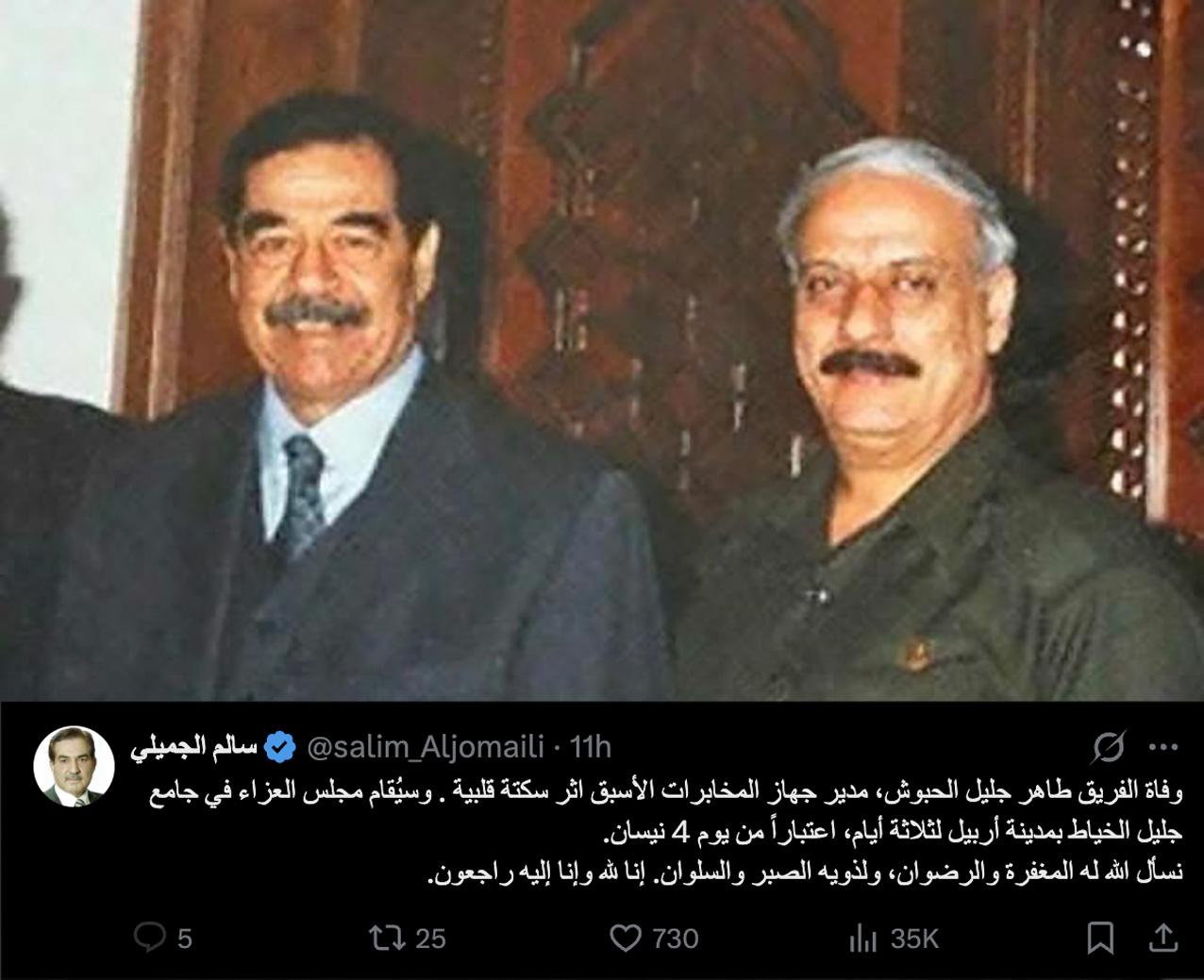
The reported death of Tahir Jalil Habboush, Saddam Hussein’s last intelligence chief, closes a chapter that never fully ended. His life after 2003—marked by disappearance, insurgency links, and quiet re-emergence in regional shadows—mirrors the unresolved legacy of Iraq’s post-invasion order.
Habboush, a native of Tikrit and a senior pillar of Saddam Hussein’s security apparatus, was among the most wanted figures after the U.S. invasion. Washington placed a bounty of up to $1 million on him, yet like several high-ranking Ba’athists, he ultimately slipped into the grey zones of regional politics rather than into custody.
Reports that his funeral will be held in Erbil—at Jalil Khayat Mosque—are striking, but not surprising. Over the past two decades, Erbil has quietly hosted a number of former regime figures. This is not an anomaly; it is part of a broader, pragmatic strategy pursued by the Kurdistan Democratic Party (KDP) under the leadership of Masoud Barzani.
Habboush was not merely a retired official seeking refuge. In the immediate aftermath of 2003, U.S. sources believed he was operating from Syria and may have played a role in managing elements of the insurgency under Izzat Ibrahim al-Douri. If accurate, this would place him among the architects of one of the most violent phases of post-invasion Iraq.
Yet his apparent presence—or at least final rites—in Erbil highlights a deeper and often overlooked reality: the Kurdistan Region’s political leadership has long engaged with figures far beyond its immediate ideological camp. This includes individuals tied to former regimes, regional intelligence networks, and Sunni Arab political currents.
Such relationships are rarely about ideology. They are about leverage.
Hosting or maintaining ties with figures like Habboush can serve multiple functions. First, many of these individuals retain connections to regional states—particularly those that have historically influenced Iraq’s Sunni political sphere. For the KDP, cultivating such links strengthens its external alliances and bargaining position.
Second, these networks have, at times, aligned with the KDP’s strategic interest in counterbalancing Baghdad. Since 2003, tensions between Erbil and the federal government have been a constant feature of Iraqi politics. Weakening central authority—whether through political pressure or alternative alliances—has often been a shared objective among disparate actors.
This dynamic is further illustrated by the role of Khamis Khanjar, one of Barzani’s closest Sunni Arab allies. His political platform has become a gathering point for many former Ba’athist-linked figures. Khanjar also played a key role in connecting Barzani with Ahmed al-Sharaa, underscoring how Iraqi, Kurdish, and Syrian networks intersect in ways that defy simple categorisation.
None of this fits neatly into moral binaries. The post-2003 Iraqi order has been shaped less by clear breaks with the past than by its quiet reintegration. Former regime figures were not entirely excluded; many were repurposed, absorbed, or tolerated within new political arrangements—especially where they could offer strategic value.
The case of Habboush, even in death, reflects this reality. His trajectory—from intelligence chief to fugitive, insurgent-linked figure, and ultimately a man whose funeral is reportedly held in one of Iraq’s most politically sensitive cities—illustrates how power in Iraq is rarely erased. It is redistributed.
For observers, the lesson is not simply about one الرجل’s legacy, but about the system that allowed such legacies to persist. In Iraq and the Kurdistan Region alike, politics operates through layered alliances, historical continuities, and calculated ambiguity.
Seeing it as black and white misses the point. The system was never designed that way.
Author Profile

- Harki is an independent investigative journalist and human rights advocate. As a member of the National Union of Journalists (NUJ), he focuses on exposing corruption and human rights abuses in Kurdistan and Iraq. He voluntarily contributes to Kurdfile Media.
 Kurdistan9 May 2026Urgent Appeal for Sherwan Sherwani’s Life
 Opinion30 April 2026Looting Under the Flag: How Power Turned War into Private Wealth
 Democracy of Hell30 April 2026A Region in Name, A Dynasty in Practice
 Barzani24 April 2026U.S. Justice Department Targets Barzani-Linked Assets in Major Corruption Probe