Dr Rebwar Fatah
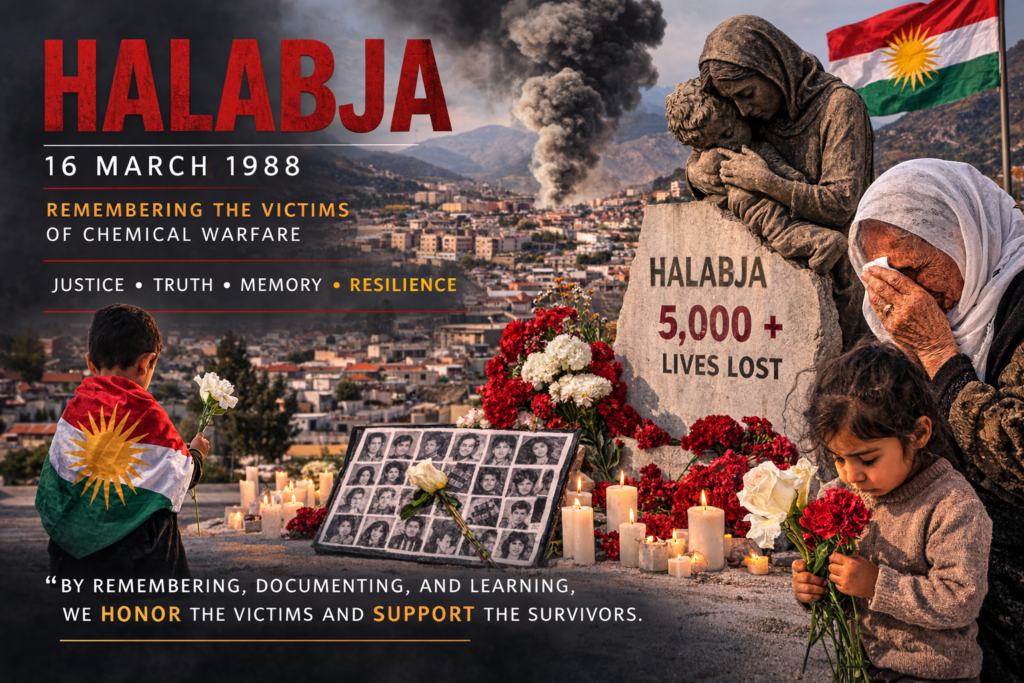
On the morning of 16 March 1988, the air over Halabja filled not with the noise of battle, but with invisible poisons that would kill thousands within hours. Around 5,000 people are believed to have died immediately, though the full toll has never been fully documented. Many thousands more suffered injuries and long-term health consequences that persist to this day.
The Attack and Its Context
The attack occurred during the closing phase of the Iran–Iraq War, shortly after Iranian forces and Kurdish fighters captured the town. Iraqi aircraft unleashed chemical agents—including mustard gas and nerve agents such as sarin and tabun—turning Halabja into a scene of mass death. Early intelligence initially confused responsibility, but later investigations confirmed Iraqi forces carried out the attack as part of the broader Anfal campaign under the regime of Saddam Hussein.
Justice Denied
Despite the scale of the atrocity, no dedicated international investigation has ever examined the full truth. Some senior Iraqi officials, including Ali Hassan al-Majid, were convicted for crimes during the Anfal campaign, but Halabja itself was never fully addressed. Saddam Hussein was executed in 2006 after being tried for other atrocities, leaving the attack legally unexamined. Victims never saw the central architect of their suffering confronted in a proper courtroom.
Political divisions in the Kurdistan Region further complicated justice. Rivalries between the Patriotic Union of Kurdistan and the Kurdistan Democratic Party fragmented the region and stalled initiatives for a comprehensive investigation.
International Responsibility
The international community also shares responsibility. Iraq’s chemical weapons program relied on foreign technology and materials, highlighted in export scandals such as the Matrix Churchill trial. Yet these inquiries focused on national accountability, not justice for Halabja. Unlike other conflicts, where tribunals were established—such as the International Criminal Tribunal for the former Yugoslavia and the International Criminal Tribunal for Rwanda—no similar forum addressed Halabja or the broader Anfal campaign.
Lasting Consequences
The consequences continue. Survivors face cancers, respiratory illness, miscarriages, and birth defects. Beyond remembrance, Halabja requires long-term medical care and research. A specialized hospital and research center could provide treatment while monitoring the population’s health, tracking mortality, and documenting the conditions of newborn generations. Supported by organizations such as the World Health Organization and the Organisation for the Prohibition of Chemical Weapons, Halabja could transform tragedy into knowledge, becoming a global center for care, research, and prevention.
Resilience and Responsibility
More than three decades later, Halabja remains a symbol of suffering—and a testament to resilience. Its scars are visible in survivors’ health, in family stories, and in a community that refuses to let its history be erased. As another anniversary passes, the people of Halabja continue to wait—not only for recognition and justice, but for the world to witness their truth. By remembering, documenting, and learning from their experience, we honor the victims, support the survivors, and ensure that the lessons of Halabja guide future generations toward accountability, care, and vigilance against the horrors of chemical warfare.

 Opinion3 June 2026The Aborted Front: Türkiye’s Veto and the Geopolitics of Arming Iranian Kurds