Freedom of Expression and Legal Limits under Iraqi and Kurdistan Region Law
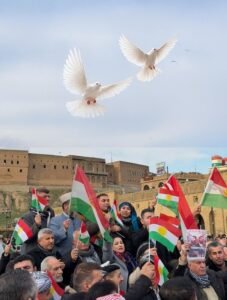
In the aftermath of military and political developments affecting the Autonomous Administration of North and East Syria (Rojava), tensions have emerged within Kurdish political and social discourse. Some Kurdish political and religious figures have publicly criticised demonstrations and civil protests organised in support of Rojava, including protests that fall within the scope of constitutionally protected rights under the Iraqi legal framework.
Reports and public statements indicate that certain actors have employed rhetoric perceived by civil society groups as dismissive or derogatory toward women and protest participants. These reactions have been interpreted by some observers as reflecting broader political alignments or ideological positions regarding developments in northeastern Syria.
The divergence of views among Kurdish political and religious actors underscores the complexity of intra-Kurdish politics and the extent to which external regional dynamics may influence domestic discourse within the Kurdistan Region of Iraq.
Legal question:
Are religious figures, when acting in a public capacity, legally permitted to use media or public platforms to verbally target or denigrate participants in peaceful demonstrations concerning alleged human rights violations in Rojava?
Under Iraqi law, freedom of expression is constitutionally protected. However, this freedom is not absolute and may be restricted where speech exceeds lawful boundaries, particularly where it affects public order, incites hatred, or undermines the rights of others.¹
Relevant Iraqi Penal Code Provisions (Law No. 111 of 1969)
Several provisions of the Iraqi Penal Code may be relevant, depending on the content, intent, and consequences of the speech:
Article 220
Addresses acts that disturb public order or public peace, including conduct or speech that may incite disorder or unrest in public settings.²
Article 433
Criminalises public insult or defamation; where directed at an identifiable group in a public context, such conduct may constitute a misdemeanour.³
Article 372
Prohibits incitement against religious, ethnic, or national groups, including speech that promotes hatred, discrimination, or hostility.⁴
Article 434
Further regulates public insults, particularly where such acts provoke social tension or unrest.⁵
Article 403
Criminalises the publication or dissemination of material that offends public morals or incites hatred, subject to judicial interpretation.⁶
Article 200
In limited and contested interpretations, has been applied to speech perceived as inciting hostility against the state or its institutions; its applicability remains context-dependent and controversial.⁷
Kurdistan Region of Iraq (KRI) Legal Framework
If the conduct occurs within the Kurdistan Region, additional regional legislation may apply:
Law No. 5 of 2015 (Protection of the Rights of Components)
Article 3 prohibits propaganda or public discourse that encourages hatred, discrimination, or violence on national, ethnic, or religious grounds.⁸
Draft “Law to Protect Sanctities” (2012)
While not enacted, this draft legislation reflects legislative sensitivity toward abusive religious discourse; it does not constitute binding law but may inform public debate and legal interpretation.⁹
Constitutional Context
The Iraqi Constitution (2005) guarantees freedom of expression under Article 38, subject to limitations necessary to protect public order, morality, and national security.¹⁰
At the same time:
Article 14 affirms equality before the law without discrimination based on ethnicity, nationality, religion, or sect.¹¹
Article 7 prohibits any individual or entity from promoting racism or sectarianism.¹²
Accordingly, speech—whether religious, political, or otherwise—that incites hatred, discrimination, or violence may fall outside constitutional protection, even when expressed within political or protest-related discourse.
Conclusion
Religious figures are entitled to freedom of expression; however, when acting in a public or influential capacity, they remain subject to the same legal constraints as other public speakers. Speech that targets peaceful demonstrators or promotes hostility toward specific ethnic, religious, or political groups may, depending on circumstances, engage criminal or civil liability under Iraqi or Kurdistan Region law.
References
Iraqi Constitution (2005), Art. 38.
Iraqi Penal Code No. 111 of 1969, Art. 220.
Iraqi Penal Code No. 111 of 1969, Art. 433.
Iraqi Penal Code No. 111 of 1969, Art. 372.
Iraqi Penal Code No. 111 of 1969, Art. 434.
Iraqi Penal Code No. 111 of 1969, Art. 403.
Iraqi Penal Code No. 111 of 1969, Art. 200; see also Human Rights Watch (2019) Iraq: Free Expression under Threat.
Kurdistan Region of Iraq, Law No. 5 of 2015 (Protection of the Rights of Components), Art. 3.
Kurdistan Parliament (2012) Draft Law to Protect Sanctities (unadopted).
Iraqi Constitution (2005), Art. 38.
Iraqi Constitution (2005), Art. 14.
Iraqi Constitution (2005), Art. 7.
Author Profile

- Dr Rebwar Fatah is a London based Middle East and North Africa (MENA) expert, provides expert analysis on the complex dynamics shaping the region. Beyond his professional pursuits, Dr Fatah is an accomplished writer, poet, and photographer, bringing a unique creative perspective to his observations of the world.
 Secuirty3 June 2026The Aborted Front: Türkiye’s Veto and the Geopolitics of Arming Iranian Kurds
- Barzani24 May 2026Dynasty and Deadlock: The KRG Governance Crisis
- Uncategorised19 May 2026The House That Was Never Built: On the Failure of Institution-Building and the Crisis of Collective Vision in Post-1991 Kurdistan
- Kurdistan15 March 2026Halabja: A Legacy of Poison, Politics, and Unfinished Justice